Psychology is the science of behaviour and experience. It is an expanding and challenging subject in the post-16 education sector. Universities increasingly see it as a valuable subject in both its own right and as a supporting subject. Students should develop as critical, scientific thinkers who are intellectually engaged with the world around them and well-prepared for further study in any discipline at university level.
The school follows the AQA A-Level Specification.
The aim of the psychology department at Aston is to stimulate curiosity, enjoyment and interest in psychology and to inspire a passion for the subject and for learning to enable success in the subject.
Teaching Staff:
Educational visits:
- Masterclasses: these take place at local universities and students will be encouraged to attend.
- Joint revision conference with King Edward VI Handsworth Boys School
- Psychological research conducted in school by local academic psychologists.
- Talks in school by psychologists.
- Online conferences
Year 12
| Summary of curriculum: |
|
| Main topics: |
In year 12, students will study:
- Approaches in psychology, including the learning, cognitive and biological approaches.
- Research methods, including scientific processes and techniques of data handling and analysis.
- Social influence, including majority and minority influence, obedience and independent behaviour.
- Memory, including models of memory and eyewitness testimony.
- Attachment, including types of attachment and deprivation.
- Clinical Psychology and Mental Health, including definitions of abnormality; characteristics and treatments of phobias, depression and OCD.
|
| How parents can support their son’s learning: |
You could support your son by encouraging them to do the following:
- They all have access to the Boost package- please encourage them to use the online textbook and all the interactive elements to stretch their learning.
- Look for opportunities to apply what they have learned in class to everyday life.
- Follow the advice given from teacher feedback.
- Create study plans or revision timetables to help them space out and balance their learning across all subjects.
- Complete questions from past exam papers for practice.
- Use websites that provide additional revision materials or videos to help them revise.
- Encourage them to use as much psychological detail as they can in their answers, including named research experiments.
- Encourage them to use specialist psychological terminology. The exam board are very keen on this!
|
| Useful websites: |
A-level Psychology 7182 | Overview | AQA
https://www.bps.org.uk/
https://thepsychologist.bps.org.uk/
https://www.tutor2u.net/psychology
|
Year 13
| Summary of curriculum: |
|
| Main topics: |
In year 13, students will study:
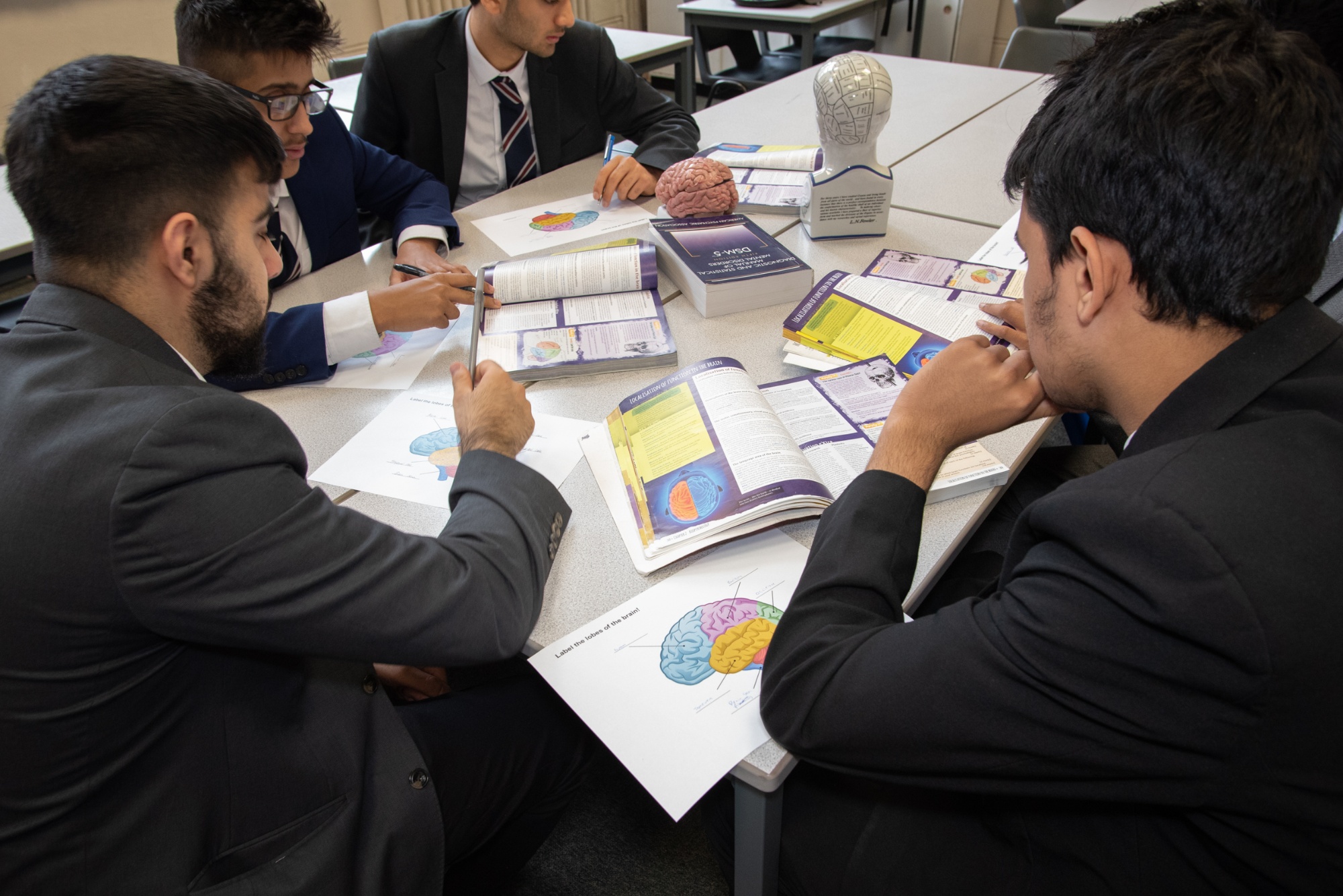
- Biopsychology, including the structure of the brain, nervous system, scanning techniques and recovery from brain injury.
- Relationships, including the formation, maintenance and breakdown of relationships.
- Aggression, including biological explanations for aggression; social and evolutionary explanations and institutional aggression.
- Schizophrenia, including symptoms, explanations and treatments for schizophrenia.
- Issues and debates, including: gender v. culture; freewill v. determinism; nature v. nurture; holism v. reductionism; idiographic v. nomathetic; and the ethical implications of research.
- Research methods, including scientific processes and techniques of data handling, analysis and statistics.
|
| How parents can support their son’s learning: |
You could support your son by encouraging them to do the following:
- They all have access to the Boost package- please encourage them to use the online textbook and all the interactive elements to stretch their learning.
- Look for opportunities to apply what they have learned in class to everyday life.
- Follow the advice given from teacher feedback.
- Create study plans or revision timetables to help them space out and balance their learning across all subjects.
- Use active learning techniques that require them to think deeply about what they are learning.
- Complete questions from past exam papers for practice.
- Use websites that provide additional revision materials or videos to help them revise.
- Encourage them to use as much psychological detail as they can in their answers, including named research experiments.
- Encourage them to use specialist psychological terminology. The exam board are very keen on this!
|
| Useful websites: |
https://www.bps.org.uk/
https://www.tutor2u.net/psychology
A-level Psychology 7182 | Overview | AQA
|